
 English


Views: 0 Author: Site Editor Publish Time: 2025-12-06 Origin: Site


Repair failures in slewing bearings can stop heavy machines fast. These bearings carry huge loads and must stay in good shape. Poor lubrication or contamination causes most failures. This post shows how to diagnose problems early and keep your slewing bearing working longer. You'll learn clear steps for repair, maintenance, and safer operation.
Understanding how a slewing bearing degrades helps engineers predict friction torque changes and prevent sudden failures. These bearings work under heavy loads, and they face shock, vibration, and constant rotation. When lubrication breaks down or contamination enters the raceway, the bearing surface begins to roughen, and friction torque rises. It often happens earlier than classical fatigue failures, as most issues start at the surface. Overloading or improper installation also accelerates wear, and it slowly changes the internal geometry until the bearing loses efficiency.
Slewing bearings fail mainly because lubrication deteriorates over time, and contamination enters the system. It causes abrasive wear, uneven torque, and early damage. Structural distortion creates uneven load paths, and overload conditions push the raceway into plastic deformation. Improper installation adds misalignment, and it creates tight spots that increase friction torque at certain rotation angles.
Operators notice early wear signs long before a bearing reaches structural failure. Axial or radial play increases gradually as the raceway material wears. Noise or vibration appears at specific angles, and the machine may feel less stable. Grease often leaks out irregularly, which suggests raceway roughness or seal degradation. Torque spikes or binding during rotation signal that friction is increasing and loading is uneven.
Working conditions create unique stress profiles. Excavators often load the bearing heavily on one side because they dig in the same area, which creates local wear zones. Cranes apply 360° rotation plus strong tilting moments, and it challenges the raceway contact geometry. Some machines operate on uneven ground, and this pushes loads repeatedly onto the same raceway region, accelerating friction rise.
Mounting accuracy affects long-term torque stability. Poor flatness at installation shifts loads toward single contact points, and the bearing begins to wear unevenly. Frames may bend slightly when machines lift heavy loads, and it changes how rollers or balls sit in the raceway. Stress then concentrates in small regions, increasing friction and producing pitting or cracking over time.
Minor wear eventually becomes structural deformation. Spalling appears when the surface layer breaks away under repeated stress. Cracks grow along the raceway, and pitting forms where contamination or high pressure weakens the material. The outer ring or inner ring may distort slightly, and gear teeth begin to mesh poorly, causing torque instability and noise.
Ignoring early degradation quickly increases repair cost. The drive pinion often wears because torque becomes inconsistent, and the gearbox suffers extra load. Machines must stop for inspection, and downtime becomes expensive. Safety risks also rise because excessive clearance reduces system stiffness, especially in lifting equipment.
Engineers examine raceway integrity, crack size, and overall geometry to decide whether a bearing can be repaired. Many units can be remanufactured if wear remains within tolerance, and new rolling elements restore original geometry. Units with deep cracks or severe deformation often need replacement because grinding cannot restore structural strength.
Condition Observed | Likely Cause | Engineering Response |
Sudden torque jump | Contamination or rough raceway | Inspect, clean, re-lubricate |
Increased clearance | Raceway wear | Measure geometry, plan repair |
Noise at rotation points | Misalignment or pitting | Check mounting, perform NDT |
Irregular grease flow | Seal or surface damage | Replace seals, inspect raceway |
Local binding | Overload or flatness issues | Verify load path, adjust mounting |
A detailed inspection helps teams understand how much damage the slewing bearing has taken and how safe it is to continue operating. It also guides every repair decision because each bearing shows different wear patterns after long use. Engineers begin this stage before any grinding or part replacement, and it ensures the repair plan remains accurate and cost-effective.
Teams measure key dimensions to record the bearing’s internal geometry. It shows how much the raceway has worn and how rollers or balls sit under load. Clearance readings help identify uneven wear zones, and it reveals where friction is rising. These measurements allow us to compare the bearing against original tolerances, then decide how much geometry can be restored.
The bearing is disassembled carefully, and each part is cleaned so engineers can detect small defects. Grease, dust, and metal particles often hide cracks, so degreasing becomes essential. Rust spots or debris are removed gently because they can distort inspection results. Once clean, the bearing’s raceway shows true wear patterns, and it becomes easier to locate stress-related damage.
Nondestructive testing helps reveal cracks the eye cannot see. Magnetic particle inspection (MPI) is widely used to locate surface and near-surface cracks in raceways, and it works well on large-diameter bearings. Ultrasonic testing detects deeper flaws hidden under hardened layers, especially where loads have been high. Dye penetrant inspection highlights tiny surface defects, and it helps confirm early-stage pitting or micro-cracks. Each method provides unique data, and they are often used together for accurate diagnosis.
After collecting measurements and testing data, engineers evaluate material condition and overall tolerance. They check how much the raceway can be reground, and whether new rolling elements can restore original geometry. It also helps determine when a bearing should be rejected because deep cracks or deformation exceed safe limits. The analysis guides decisions on oversize rolling elements, seal replacement, and the level of grinding required.
Inspection Step | Purpose | Key Findings Used For |
Dimensional checks | Map geometry loss | Clearance, raceway wear |
Cleaning & prep | Reveal true surface | Rust, pitting, debris |
MPI / UT / DPI | Identify hidden defects | Crack depth, surface damage |
Engineering evaluation | Decide repair scope | Repairability, tolerance limits |
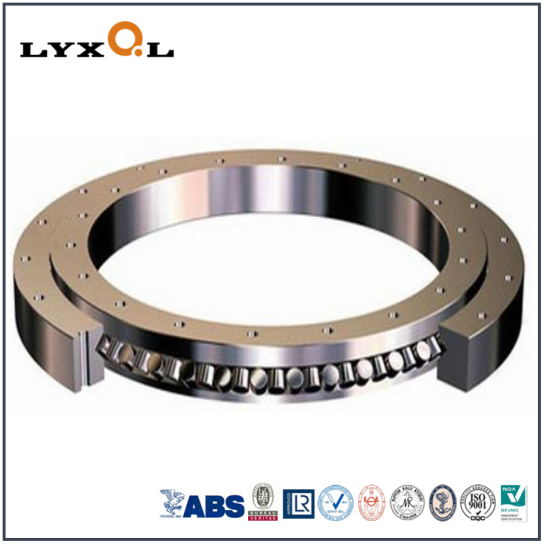
Repairing a slewing bearing requires precise work because each part influences load distribution and long-term performance. Engineers follow a structured sequence, and it helps restore geometry, surface quality, and rotational stability. These processes handle surface damage, wear, misalignment, and gear issues while keeping the bearing’s original function intact.
Regrinding corrects the raceway shape and removes worn material, and teams often grind it to a higher precision than new parts. This step restores the correct contact angle so the load spreads evenly across the rolling elements. It is especially important for crane bearings, where a 60° four-point contact design must maintain exact geometry. When done correctly, regrinding lowers friction, improves torque stability, and prepares the bearing for new rolling components.
Once regrinding removes material, oversized rollers or balls help compensate for the loss and restore proper internal clearance. Engineers also replace cages or separators because they may deform under heavy loads. New seals go in to protect fresh surfaces and keep contaminants away. After these parts are installed, the bearing returns to its original geometry, and it operates more smoothly under complex loads.
Localized damage often needs material restoration before grinding. Welding or surfacing builds up worn areas when the raceway has deeper pits or cracks. Thermal spray coatings add a high-strength layer onto damaged regions, and it works well for corrosion-affected bearings. Some repair teams also use low-temperature iron plating to restore dimensions quickly, and it avoids excessive heat input. These techniques strengthen the surface, reduce future wear, and improve service life after machining.
Engineers examine gear conditions carefully because worn teeth create noise and irregular torque. Re-cutting restores tooth profiles where wear is moderate. Grinding removes burrs or uneven edges, while hard-facing adds durable material to severely worn sections. After repair, the gear must mesh correctly, and backlash is checked during reinstallation to prevent binding or noise during operation.
Assembly begins once all components pass inspection, and every surface receives fresh lubrication. Teams check rotation by hand to confirm smooth movement, and they adjust clearances where needed. Each bearing receives a serial number so future inspections, lubrication intervals, and repair history remain traceable. This practice ensures consistent quality because technicians can verify performance at any time.
Repair Stage | Main Actions | Purpose |
Raceway regrinding | Restore geometry, improve accuracy | Reduce friction, correct load paths |
Rolling parts replacement | Install oversized rollers, new seals | Recover internal clearance |
Surfacing options | Welding, thermal spray, plating | Fix surface wear or corrosion |
Gear repair | Re-cut, grind, or hard-face | Restore proper meshing |
Final assembly | Lubricate, inspect, serialize | Ensure reliability and traceability |
Tip: Each repair step contributes to stable performance during heavy-duty operation, and it prepares the slewing bearing for a long service cycle.
Performance testing shows how well the slewing bearing functions after repair, and it confirms whether the restored geometry can handle real operating loads. Engineers run several checks because each test highlights a different failure risk. These steps help ensure the bearing rotates smoothly, holds load safely, and keeps lubrication sealed inside.
Rotation testing happens first because it reveals issues before heavier evaluation begins. The bearing rotates by hand or under a low-speed motor, and engineers feel for smooth, even movement. Any torque spike, vibration, or binding point suggests unfinished raceway corrections or misalignment inside the assembly. It also shows whether rolling elements seat properly after regrinding and cage replacement, and it gives early clues about friction changes.
Load testing validates structural strength by applying pressure similar to working conditions. Engineers check how the bearing reacts when loads shift, and they listen for noise from gear teeth. Backlash testing focuses on tooth engagement, and it ensures the pinion and internal or external gear mesh without binding. Uneven contact creates rapid wear, so this step confirms the repair restored proper tooth geometry. The bearing must hold its load steadily, and any tilt or excessive play leads to additional adjustment or further inspection.
Seal testing checks for leaks because lubrication loss directly causes early failures. Engineers pressurize or rotate the bearing slowly, and they look for grease escaping around the seals. The grease must stay inside the raceway because it protects rolling elements from contamination. Rust or dirt often caused original damage, so strong seal performance becomes essential after repair. Good grease retention indicates the bearing can maintain long service intervals under field conditions.
Once mechanical and lubrication tests finish, the bearing is compared against OEM specifications. Many refurbished slewing bearings match or exceed new-unit performance because regrinding often improves accuracy beyond factory tolerances. Geometry, clearance, and torque readings fall within strict limits, and documentation confirms each step. This compliance record helps users track future maintenance and proves the bearing is ready for installation.
Test Type | Purpose | Key Checks |
No-load rotation | Detect movement issues | Smooth rotation, stable torque |
Load testing | Confirm structural strength | Deformation control |
Backlash check | Validate gear performance | Tooth contact accuracy |
Seal inspection | Ensure lubrication security | No leaking, clean surfaces |
Standards compliance | Match OEM limits | Geometry and torque values |
Preventive maintenance keeps a slewing bearing stable under heavy loads, and it helps delay major repairs. These bearings work in harsh environments, so small problems grow quickly when lubrication or inspection routines fall behind. A structured plan reduces friction, prevents corrosion, and protects internal geometry from overload.
Lubrication prevents metal-to-metal contact, and it remains the most important factor in extending bearing service life. The correct grease type must match load intensity and operating temperature, and teams apply it at regular intervals. Quantity also matters because too much grease causes heat buildup, while too little leaves rolling elements exposed. Engineers watch for waviness, pitting, or early spalling, as these signs show lubrication breakdown. Studies show more than 96% of premature failures begin when lubrication becomes inadequate, so teams must treat this step as a priority.
Inspection schedules follow working hours, and a 500-hour check helps detect surface changes early. Monthly inspections cover corrosion, bolt tightness, and noise during rotation. Quarterly inspections look deeper at clearance changes, raceway marks, or seal degradation. Inspectors track small cracks or shifts in axial or radial movement, and the data helps determine when repairs should begin before failure becomes severe.
Slewing bearings operate best in clean, controlled environments, and contamination creates rapid wear. Dust enters seals easily when conditions stay dry or windy, so operators keep the area clean. Humidity also affects the raceway, and uncontrolled moisture causes corrosion or rust. During assembly, a dust-free space and stable temperature protect new surfaces from damage, and this prevents early deterioration once the machine begins running.
Operators influence wear patterns through daily habits, and uneven work can degrade one sector of the raceway. Machines should rotate through a balanced range instead of repeating the same angle, and this spreads load across the entire surface. Avoiding overload or side-loading keeps internal geometry stable. Heavy lifts must stay within rated limits, and smooth transitions between motion reduce impact forces inside the bearing.
Proper storage and careful installation help a slewing bearing start its service life in the best condition. These steps protect the raceway, seals, and gear teeth before the machine operates under load. Small errors in storage or mounting create early wear, and they often lead to noise or misalignment once the bearing rotates.
Storage conditions must stay stable because temperature changes affect the anti-rust coating. A range of 0–25°C keeps the coating intact, and humidity stays between 45–60% to prevent corrosion. Teams avoid chemicals because vapors from acids or salts damage the surface easily. The bearing remains off the ground to prevent moisture absorption, and the warehouse stays clean so dust cannot settle on exposed areas.
Handling requires slow and steady movement to avoid impact damage. The bearing is heavy, so teams use lifting lugs or soft slings to protect it. Correct lifting methods prevent bending moments on the rings, and it keeps rolling elements from shifting during transport. A dropped bearing often develops hidden cracks, so safe handling becomes a critical step before installation.
Installation accuracy determines how evenly the load spreads across the raceway. The mounting surface must be flat and rigid, and teams verify flatness before positioning the bearing. Bolts tighten in a cross-pattern sequence, and it prevents distortion while the ring seats itself. Gear backlash is adjusted according to gear runout because incorrect meshing produces abnormal noise and rapid tooth wear. When installation lacks precision, the bearing develops tight spots or excessive play, and this reduces service life.
After the bearing is mounted, engineers rotate it slowly to confirm smooth movement. Any rough point or sudden torque change signals alignment issues. Gear engagement is checked next, and the pinion must mesh cleanly without binding. Preload and clearance receive final verification because they influence stiffness under load. When these values fall within specification, the bearing is ready for operation.
Stage | Key Requirements | Purpose |
Storage | 0–25°C, 45–60% humidity, no chemicals | Prevent corrosion and coating damage |
Handling | No impacts, correct lifting tools | Avoid structural deformation |
Installation | Flat mounting, torque sequence, backlash set | Ensure correct load distribution |
Validation | Smooth rotation, proper gear contact | Confirm operational readiness |
Repair and preventive care help slewing bearings last longer and often perform like new. Proactive inspection and proper lubrication keep machines stable. Good installation also prevents early damage. Understanding failure signs lets operators act early and reduce cost. LYXQL supports these needs by offering reliable products and helpful services that improve long-term equipment performance.
A: A Slewing Bearing shows wear when noise, vibration, or rising torque appear.
A: A Slewing Bearing needs routine checks for lubrication, clearance, and corrosion.
A: A Slewing Bearing can be repaired when raceway wear and cracks stay within limits.
A: A Slewing Bearing fails early when grease breaks down or contamination enters.
