
 English


Views: 0 Author: Site Editor Publish Time: 2025-12-05 Origin: Site


Port cranes face extreme loads and harsh weather. A single failure in the slewing bearing can stop operations. Why does this component matter so much? It carries axial, radial, and moment forces while allowing smooth 360° rotation. This article explains the key technical requirements for port-crane slewing bearings, based on real engineering standards. In this post, you’ll learn what makes a bearing safe, durable, and ready for demanding port work.
Performance & Load Requirements for Port Crane Slewing Bearings
Port cranes place extreme mechanical demands on the slewing bearing, and it must carry large axial, radial, and overturning moment forces every day. These forces act together as the crane lifts containers, swings loads across the berth, and stops suddenly during braking. The bearing must resist these loads without distortion, since even small alignment errors can reduce accuracy. Engineers rely on strict standards, and they design bearings that survive heavy compression on the load side and tension on the opposite side, a pattern seen in all port-side operations.
The slewing bearing handles weight from the load, the boom, and the crane structure, and it transfers these forces safely into the support ring. Axial load grows when the crane lifts heavy cargo, and radial load appears as the boom moves across the deck. Overturning moment increases when outreach changes, so the bearing needs strong raceways, hardened surfaces, and precise rolling elements to keep movement smooth.
A port crane repeats the same motions for long hours, so fatigue life becomes critical. Bearings must endure millions of load cycles, and they depend on clean raceways, consistent hardness, and stable material strength. When bearings run under heavy loads for many shifts, small stress points can expand, and fatigue damage may spread, which is why manufacturers use strict hardness ranges and material rules.
Loads in a port environment change quickly. A sudden stop during rotation pushes shock into the bearing, wind gusts add moment forces, and uneven cargo weight can shift the center of gravity. These dynamic effects require stable rollers or balls, strong rings, and reliable gear accuracy, because even short spikes can accelerate wear.
Cranes often work facing the water, so loads rarely remain balanced. The bearing must distribute these forces evenly, and engineers adjust contact angles, ring stiffness, and roller arrangement to reduce concentrated stress. Proper distribution lowers friction, avoids raceway damage, and keeps rotation smooth for long periods.
Rigidity inside the bearing determines how accurately the crane can rotate, especially during slow positioning. If the ring flexes, the jib may shake, and the operator loses fine control. Strong materials, correct quenching depths, and tight gear tolerances keep the structure stiff so the crane can stop and start smoothly.
Emergency stops can create violent impulses. The bearing needs enough toughness to absorb these shocks without cracks or spalling. Manufacturers use controlled heat treatment, hardened layers, and strong core toughness to handle these events, and they test bearings under simulated impact to ensure stability.
Port cranes follow strict safety rules, so engineers design slewing bearings with high safety factors. These factors account for overload events, windstorms, and operational mistakes. The table below shows how typical load types influence safety factor selection.
Load Type | Effect on Bearing | Required Safety Consideration |
Axial Load | High compression on raceways | Larger contact area, stronger rings |
Radial Load | Side force during swing | Precision rollers, rigid structure |
Overturning Moment | Large tilt forces | Increased ring thickness |
Dynamic Shock | Braking or wind gusts | Toughened materials, deep hardening |
Fatigue Cycles | Repeated operations | Long-life steels, accurate geometry |
The gear system on a port crane’s slewing bearing drives rotation, and it must stay accurate under heavy loads and long duty cycles. Port cranes often rotate while lifting large containers, so the gear must resist wear, handle shock, and maintain proper tooth contact. Engineers use strict standards, and they inspect gear accuracy to ensure smooth, safe movement during daily operations. Even small gear errors can cause noise, vibration, or tooth failure, especially when cranes work near the sea where corrosion develops quickly.
Most slewing bearings use a straight-tooth involute gear. It gives stable meshing, low sensitivity to minor misalignment, and predictable wear. The design usually includes a +0.5 shift coefficient, which helps the gear avoid undercutting and improves tooth strength. This shift also increases load capacity, especially when the crane works at long outreach. Engineers rely on this geometry because it handles high torque without sharp stress points.
The modulus controls tooth size, and it must match the crane’s torque and speed demands. Larger modulus means stronger teeth, and it suits heavy operations like container handling. Smaller modulus works for lighter systems but rarely appears on port cranes. GB1357 gives standardized modulus choices, and it helps maintain compatibility between the gear and the pinion. When engineers select a modulus, they consider torque, motor power, wind load, and expected wear.
Gear accuracy affects rotation smoothness. Port cranes need stable rotation even at slow speed, so high accuracy becomes important. GB10095 class 11FH sets limits for tooth thickness deviation, pitch errors, and profile accuracy. These rules ensure that each tooth engages smoothly, preventing shock during meshing. If tooth thickness drifts, the pinion may jam or slip, and the crane may vibrate. Engineers measure these deviations after machining, and they recheck them after heat treatment.
The gear surface must resist wear because the pinion delivers continuous torque. Hard surfaces extend service life, and they protect the crane from sudden gear failure. Heat treatment increases hardness, while still keeping the core tough enough to resist cracking. Proper hardened depth ensures it doesn’t wear through the hard layer too quickly. In port environments, corrosion can weaken the surface, so protective coatings often support the hardened layer.
The support ring forms the structural backbone of a port crane slewing bearing. It carries large axial and moment loads, and it keeps the raceway stable during rotation. Engineers rely on strong steel, consistent heat treatment, and controlled hardness because the ring must stay tough, even in cold or corrosive port environments. When a crane swings heavy cargo, the raceway takes repeated stress, so every detail—from hardness depth to soft-belt positioning—affects long-term reliability.
Support rings often use 42CrMo steel because it offers high strength and stable toughness. After quenching and tempering, it reaches HB260–300, a level that balances hardness and flexibility. This helps the ring resist cracking as the crane lifts and rotates. Engineers choose this material because it handles shock, and it maintains strength even after long use.
Port cranes may work in cold regions, so the steel must absorb impact at low temperatures. The ring needs impact energy ≥42J at −20°C, so it stays safe when the crane faces sudden loads. If toughness drops, the ring may fracture under stress, so this requirement protects it against brittle failure.
The raceway sees direct contact from balls or rollers, so it needs a hardened layer. Engineers target HRC55–60 on the surface for wear resistance. Beneath this layer, hardness must stay above HRC48 to a specified depth. This prevents early fatigue. It also keeps the raceway from flattening under repeated high loads.
Heat treatment creates a “soft belt,” a lower-hardness region on the ring. Its width must stay within set limits, and it must be placed away from high-load areas. When holes block the heat path, the soft belt aligns differently, so markings guide correct assembly. These marks help technicians avoid placing the weak zone under peak stress.
Requirement | Specification | Purpose |
Material | 42CrMo steel | High strength, stable toughness |
Hardness | HB260–300 | Balanced rigidity and durability |
Low-temp impact | ≥42J at −20°C | Prevent brittle failure |
Raceway hardness | HRC55–60 | Wear resistance |
Hardened depth | ≥HRC48 zone | Long fatigue life |
Soft-belt control | Limited width + proper marking | Safe installation |
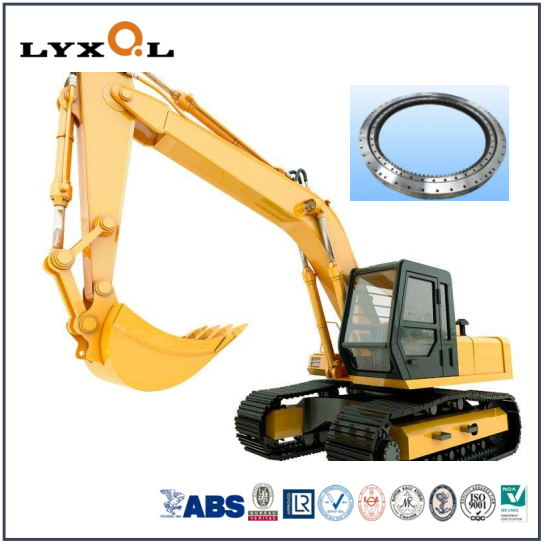
Port crane slewing bearings operate in harsh coastal environments, so sealing and lubrication systems become critical. Salt spray, heavy dust, moisture, and constant load cycles push the bearing to its limits. To stay reliable, the bearing needs strong spacers, durable sealing rings, corrosion-resistant oil paths, and lubricants that survive humidity. Each element works together to protect the raceway, the rolling elements, and the gear from wear and contamination.
Spacers made from PA1010 resin keep rolling elements apart, and they reduce friction during rotation. PA1010 handles repeated compression well, so it helps the bearing move smoothly under heavy loads. When rollers stay properly separated, they avoid metal contact, and wear drops sharply. Engineers also choose PA1010 because it resists water absorption, which improves stability near the sea.
The sealing ring, often made of NBR, prevents dust, mud, and water from reaching the raceway. NBR has strong oil resistance, and it stays flexible in different temperatures. When a crane works in rain or fog, the seal blocks moisture, and it keeps grease inside. Even small gaps can cause corrosion, so the seal’s quality directly affects bearing life.
Oil holes allow grease to enter the bearing, and they must resist corrosion. Engineers use materials that survive salt spray, since port cranes face this daily. A corroded nozzle may clog, and grease cannot reach critical areas. Seawater-resistant nozzles maintain smooth flow, and they help operators refill grease quickly.
Lubricants for port cranes must resist water, and they must stay stable under heavy pressure. Grease needs good adhesion so it stays on the raceway during rotation, even when wind and humidity rise. In salt-spray zones, water-resistant grease prevents rust, and it forms a protective film. Technicians follow a strict lubrication schedule because clean grease keeps wear particles out and protects hardened surfaces.
Component | Material / Standard | Function |
Spacer | PA1010 resin | Reduces wear, stabilizes rolling motion |
Seal ring | NBR | Blocks dust and moisture |
Oil hole | Corrosion-resistant metals | Ensures clean lubrication flow |
Nozzle | Seawater-resistant type | Prevents clogging in port conditions |
Lubricant | Water-resistant, high-pressure grease | Protects raceway surfaces |
Tip: These requirements help ensure the bearing stays protected as the crane works through demanding port operations.
Port cranes operate near seawater, so corrosion becomes a constant threat to slewing bearings. Salt spray, humid air, and frequent rain all speed up rust formation, and they weaken critical bearing surfaces. The bearing must resist these conditions to maintain safe rotation, and engineers use coatings, sealing systems, and storage methods to protect each component. Dust from bulk terminals and long idle periods add more stress, so environmental protection becomes as important as mechanical strength.
Salt spray reaches the bearing surface easily, especially when cranes work on exposed berths. Engineers apply anti-corrosion coatings, and these coatings slow rust on the gear ring, bolts, and exposed metal. Zinc plating, epoxy systems, and marine-grade paints all help the bearing survive long exposure. When salt settles on unprotected surfaces, it enters gaps and damages hardened layers, so coatings create a strong barrier.
Humidity rises quickly near the sea, and rain can reach the gear or sealing areas. Strong sealing rings keep moisture out, and they prevent water from mixing into the lubricant. A wet raceway loses oil film strength, and wear accelerates. Waterproof covers or protective shields also help during storms. When cranes work near tidal zones, humidity spikes, so stable seals become essential for long-term performance.
Bulk terminals generate high dust levels as ships unload materials. Dust can enter open gear areas, and it mixes with grease, forming abrasive paste. Sealing systems block this dust, while proper lubrication flushes particles out. Operators often clean exposed surfaces because dust increases friction and changes wear patterns. Preventing contamination keeps gear teeth and raceways smooth.
Some cranes stay idle for weeks, and moisture settles on bearing surfaces. Engineers use rust-preventive grease, storage covers, and periodic rotation. These actions spread lubricant evenly and stop condensation from sitting in one place. Idle bearings corrode faster, so protective coatings and regular inspection help them stay safe.
Risk Factor | Required Protection | Effect on Bearing |
Salt spray | Marine coatings, plating | Slows rust formation |
High humidity | Strong sealing, waterproofing | Prevents moisture ingress |
Dust contamination | Enhanced sealing, cleaning | Reduces abrasive wear |
Long idle periods | Anti-rust grease, rotation | Prevents condensation damage |
Port crane slewing bearings must meet strict requirements. They need strong materials, precise gears, durable seals, and corrosion protection. These features keep cranes safe in harsh marine environments. Understanding these factors helps engineers choose better bearings and plan maintenance. LYXQL offers high-quality solutions that improve reliability and support long service life.
A: A Slewing Bearing must follow strict rules for load capacity, gear accuracy, sealing, and corrosion resistance.
A: It protects the Slewing Bearing from wear, and it keeps rotation stable under heavy loads.
A: They use coatings, strong seals, and water-resistant grease to protect the Slewing Bearing.
A: Load cycles, lubrication quality, material strength, and environmental exposure all shape its lifespan.
