
 English


Views: 0 Author: Site Editor Publish Time: 2025-12-16 Origin: Site


Is your slewing bearing really protected when something goes wrong? Many buyers assume the warranty covers everything, but that is rarely true. The warranty of a slewing bearing directly affects safety, uptime, and repair costs. In this post, you'll learn what warranties really cover, what they exclude, and why quality and inspection matter.
A standard Slewing Bearing warranty clearly separates manufacturing defects from normal operational wear. Manufacturing defects relate to errors in material selection, machining accuracy, heat treatment, or assembly quality. If cracks appear in the raceway, rolling elements fail prematurely, or abnormal vibration occurs under correct operating conditions, they usually fall under defect coverage. Normal wear, however, develops gradually during proper use. Surface polishing of raceways, slight gear backlash growth, or seal aging over time are expected behaviors. They reflect service life, not failure. This distinction protects manufacturers from misuse claims and helps users understand when a warranty claim is valid.
Material quality plays a direct role in warranty coverage. Most manufacturers apply strict alloy steel standards and controlled heat treatment processes to ensure stable hardness and load capacity. Raceway hardening improves wear resistance and fatigue life, while gear hardening protects tooth profiles under repeated torque. When hardness levels or surface integrity fall outside design limits during correct use, warranty protection often applies. Inspection records, traceability data, and factory testing all serve as proof points. They link manufacturing quality to long-term operational reliability and support warranty decisions.
Warranty coverage typically extends across multiple load-carrying and motion-critical components, rather than targeting a single part. Gear systems on internal or external rings receive protection when tooth cracking, abnormal pitting, or manufacturing misalignment occurs under rated loads. Seals receive coverage when leakage results from faulty installation at the factory, not from damaged lubrication intervals. Rolling elements receive similar protection when spalling or deformation appears under correct load distribution. These components operate as a system, not as isolated parts, so warranty terms usually treat them as an integrated mechanical unit.
Warranty duration is usually defined by both calendar time and operating hours. Time-based limits protect against long-term storage risks, environmental exposure, and seal aging. Hour-based limits relate to fatigue life and accumulated load cycles. A slewing bearing used continuously in heavy-duty equipment will reach its operational threshold faster than one in intermittent positioning systems. This dual limitation protects both the buyer and the supplier. It prevents unlimited claims while still offering meaningful protection in early service life.
Coverage Area | Typical Warranty Scope | Common Exclusions |
Raceway and Rings | Material defects, heat treatment errors | Corrosion from poor lubrication |
Gears | Manufacturing cracks, abnormal wear patterns | Improper backlash adjustment |
Rolling Elements | Early spalling from defects | Overload-induced deformation |
Seals | Factory installation faults | Aging from poor maintenance |
Duration Limits | Time and operating hour thresholds | Excessive duty beyond design |
Correct installation decides whether a Slewing Bearing warranty stays valid from day one. We install it only on clean, flat, and rigid mounting surfaces. Bolts must follow a cross-tightening sequence, not a circular pattern. They tighten in stages, usually 60%, then 80%, and finally full torque. If they tighten unevenly, stress concentrates in one zone. It leads to oval deformation and early raceway damage. We also verify torque again after initial running hours, because settling always happens.
Lubrication forms the first defense against friction, heat, and corrosion. They receive factory grease, but storage time changes everything. We always regrease before installation if storage exceeds several months. Raceways need fresh grease at fixed duty intervals, while gears require open gear lubricant after backlash setup. If they mix incompatible greases, seals soften and leakage follows. Missed lubrication voids warranty fast. Excess grease matters too, since pressure can push seals outward.
Warranty protection starts even before installation. They travel only in horizontal positions or on dedicated incline racks. Vertical storage bends large rings under their own weight. We avoid shock loads, moisture pooling, and direct ground contact. Light surface rust on outer faces is manageable. Rust inside raceways is not. Grease film stays critical during storage. If corrosion spreads due to open exposure, warranty claims rarely survive inspection.
Slewing bearings behave as elastic structures. They depend on flat, stiff support rings to carry loads evenly. If mounting faces exceed flatness limits, local raceway overload follows. It causes tight spots, noise, and early pitting. Thin support plates add risk, even if bolts meet torque values. We prefer thick, continuous rings over ribbed plates. When machining cannot meet tolerance, resin leveling compounds serve as controlled alternatives.
Some fastening methods cancel warranty instantly. Elastic washers, serrated washers, and spring washers fall into this risk category. They reduce clamp stability under cyclic loads. For certain steel grades, hardened flat washers remain mandatory to control surface pressure. Untreated bolts need light oil, not dry tightening. If they use undersized bolts in clearance holes, shear loads increase sharply. Manufacturers treat these mistakes as misuse.
Seals protect raceways from dust, water, and debris. They also keep grease where it belongs. We inspect seals during annual maintenance, sooner in aggressive environments. Small grease weep is normal. Heavy leakage signals seal damage. If contaminants enter the raceway, abrasive wear accelerates fast. Warranty rarely applies once contamination damage appears. Replacement seals must match material type, not generic rubber strips.
Warranty-Sensitive Condition | Correct Practice | High-Risk Mistake |
Bolt tightening | Cross-pattern, staged torque | Circular tightening |
Raceway lubrication | Scheduled regreasing | Dry running |
Gear lubrication | After backlash setup | No open gear grease |
Storage orientation | Horizontal or incline racks | Vertical ground storage |
Mounting flatness | Machined support rings | Ribbed thin plates |
Washers | Hardened flat washers | Spring or serrated washers |
Seal control | Routine inspection | Ignored leakage |
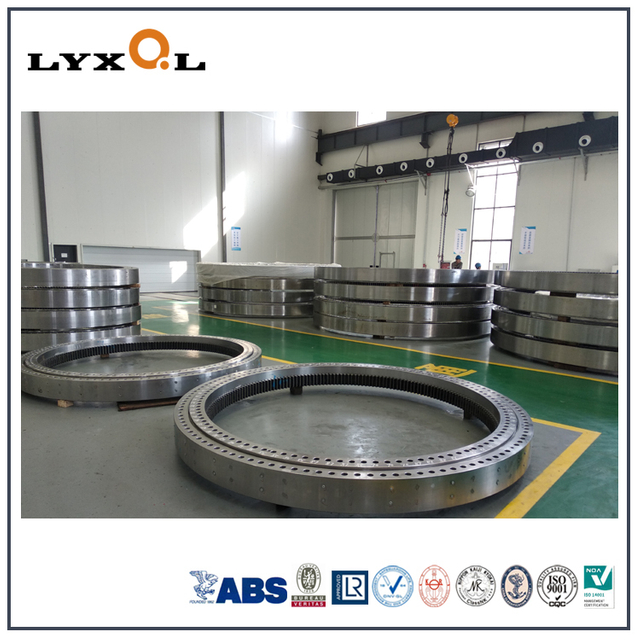
Every Slewing Bearing carries load only inside its calculated limits. When axial force, radial force, or tilting moment rises above design values, internal stress rises fast. They deform raceways, compress rolling elements, and twist mounting bolts. The damage may not appear at once, but fatigue grows silently. We often see early pitting, uneven wear bands, and rising turning torque. Once inspections confirm overload damage, warranty protection usually ends.
Gear systems depend on controlled backlash and precise alignment. If they set backlash too tight, tooth flanks run hot, friction increases, and wear accelerates. If backlash turns too large, impact loading forms along the tooth edge. Pinion shafts often shift under vibration, especially if motor mounts lack stiffness. When tooth contact shows uneven flank patterns, inspectors trace this to misalignment. Warranty coverage rarely applies under these conditions.
Lubricants form a chemical system, not simple oil. They match base oil viscosity, thickener type, and temperature range. If we mix incompatible greases, separation occurs. Oil bleeds out, thickener hardens, seals soften. Raceway films break down, corrosion starts under load. Wrong gear grease causes teeth scoring and noise. Once lab analysis confirms incorrect lubricant use, warranty claims almost always fail.
A Slewing Bearing leaves the factory as a sealed mechanical system. When they open it in the field, alignment changes. Rolling elements escape controlled spacing. Seals lose preload and geometry. Field machining of bolt holes or gear teeth adds further risk. Even small changes shift load paths. Inspectors treat such actions as structural modification. At this point, warranty responsibility ends at the date of alteration.
A Slewing Bearing often works far longer than its warranty period. Warranty focuses on early-stage manufacturing risk, not full fatigue life. We see warranties tied to months or limited operating hours, while real service life spans years. They design bearings for heavy loads and slow speeds, but usage conditions vary widely. Shock loads, extreme temperatures, and contamination raise uncertainty. Manufacturers limit warranty time to control exposure. It protects buyers at startup, not across the entire lifecycle.
Wear develops gradually inside raceways and rolling elements. It increases operational clearance, even when it runs smoothly. We track clearance growth under known loads as a reference baseline. When wear accelerates, it signals surface fatigue, lubrication breakdown, or support distortion. Replacement timing depends on measured growth, not calendar age. Many operators plan replacement when deflection reaches about 1.5 times its initial value. Beyond that, motion stability drops and risk rises. At two times the original deflection, unsafe conditions often appear.
Deflection measurement turns service life into a data-driven decision. We record initial elastic deflection after installation, then compare it during inspections. They measure under repeatable load positions to keep results meaningful. A rising trend warns long before noise or vibration begins. It also helps with procurement planning, since large bearings involve long lead times. Predictive tracking prevents sudden shutdowns and cost spikes. Warranty rarely connects to these later-stage behaviors, but service life depends on them closely.
Aspect | Warranty Focus | Service Life Focus |
Time frame | Short-term protection | Full operational lifespan |
Primary risk | Manufacturing defects | Fatigue, wear, clearance growth |
Trigger for action | Early failure | Measured deflection increase |
User responsibility | Correct installation, lubrication | Continuous inspection, trend tracking |
End condition | Claim approval or rejection | Planned replacement |
Tip: Warranty and service life operate on different clocks. We use the warranty to secure early reliability. We use wear trends and deflection data to manage the long-term future of a Slewing Bearing.
Warranty support often begins at installation, not after failure. We guide lifting methods, bolt tightening sequences, and backlash setup. It helps prevent early damage caused by uneven preload or misalignment. They verify lubrication before rotation starts, and they check seal seating after first turns. Commissioning also includes noise checks, torque trends, and temperature observation. If these steps follow approved procedures, the warranty remains intact. If they skip them, even a new Slewing Bearing may lose coverage early.
On-site assistance focuses on correctness at the start. It reduces disputes later, because installation errors rarely qualify for warranty claims.
Long-term technical service takes over after the warranty phase. We perform annual inspections to assess wear, clearance growth, seal condition, and gear tooth contact. They track bolt torque consistency and grease condition under real duty cycles. Fault diagnosis relies on sound, vibration, and turning resistance trends. Small changes reveal larger risks ahead. Service teams also adjust lubrication intervals when conditions change, such as dust, moisture, or heavy shock loads. Warranty support fades with time, but technical service grows more important as fatigue accumulates.
This service stage protects uptime rather than claim eligibility. It shifts focus from factory responsibility to operational stability.
Large Slewing Bearing replacements often involve long manufacturing lead times. When downtime cannot wait, reconditioning becomes a strategic option. We inspect raceways, regrind worn zones, replace rolling elements, renew seals, and restore lubrication channels. They also repair minor gear damage when geometry remains within limits. Reconditioned bearings extend usable life without full replacement. Warranty no longer applies, but controlled service risk remains acceptable for many operations.
This option depends on structural integrity. If cracks, deep brinelling, or severe ovality appear, reconditioning loses value. In such cases, full replacement stays the only safe solution.
Warranty length looks simple at first, yet exclusions define its real value. One supplier may offer twelve months, another eighteen. The difference means little if harsh conditions cancel coverage. We check exclusions for shock loads, dust, moisture, and extreme temperature. They often exclude offshore exposure, high-speed rotation, or frequent reversing duty. Some limit axial load ratios or tilting moments beyond catalog values. A longer warranty loses strength when exclusions grow wide. Buyers compare time and limits together, not in isolation.
They also review start dates carefully. Some start at delivery, others at commissioning. Storage delays shorten real protection if the clock starts too early.
OEM warranties follow the original machine design logic. They match calculated loads, support structure rules, and lubrication plans. When we install an OEM unit correctly, alignment stays predictable. Aftermarket replacements offer flexibility, often faster delivery and lower cost. Their warranty, however, may assume generic duty conditions. They may restrict dynamic loading or gear torque more tightly.
OEM suppliers usually link warranty to system behavior. They analyze bolt forces, raceway load curves, and gear strength together. Aftermarket units often focus on the bearing alone. When failure occurs, responsibility becomes harder to trace. We compare not only price and time, but also how deeply each supplier understands the application.
Documentation shapes warranty enforcement more than many expect. We look for serial numbers, batch records, material certificates, and heat treatment reports. These link the bearing to its production history. QA files also include dimensional checks, hardness records, and functional rotation tests. When they appear complete, disputes resolve faster.
Traceability protects buyers in another way. If similar failures appear across batches, they reveal systematic risk. Without records, it becomes one claim against one supplier. With records, it becomes a documented pattern. That difference changes negotiation strength. Clean documentation also supports resale value for machines and long-term maintenance planning.
Slewing bearing warranty depends on both the manufacturer and the user. Correct installation, proper lubrication, and regular inspection protect both warranty and service life. Clear records and careful operation reduce long-term risk and unexpected downtime. LYXQL provides reliable slewing bearing solutions, stable quality control, and responsive service, helping customers protect equipment value and ensure safe, long-term operation.
A: It covers manufacturing defects in raceways, gears, seals, and rolling elements under normal use.
A: Use correct installation, proper lubrication, and follow regular inspection schedules.
A: Warranty protects early defects, while service life depends on wear and operating conditions.
A: Usually no, aftermarket warranties are shorter and have more exclusions.
A: Overloading, wrong grease, poor backlash setup, and unauthorized disassembly.
